Sequel Pro alternatives for Mac in 2026
Sequel Pro hasn't had a stable release since 2016. Compare Sequel Ace, TablePlus, Querious, DBeaver, MySQL Workbench, DataGrip and dbPlus for MySQL on a Mac.
Sequel Pro's last stable release, 1.1.2, came out in April 2016, and it struggles with current MySQL servers and modern Macs. The natural replacement is Sequel Ace, a free, open-source fork that looks and works like Sequel Pro and is actively maintained. If you want more than MySQL and MariaDB, or a more polished commercial app, TablePlus, Querious, DataGrip, DBeaver, MySQL Workbench and dbPlus are the main options.
We make dbPlus, so treat our take on it with some care. We've tried to be fair to every app here, including the free ones that compete with ours.
What happened to Sequel Pro
For years Sequel Pro was the free MySQL client most Mac developers reached for. Development slowed after 1.1.2, released on 3 April 2016. The GitHub repository shows no stable release since then, and its main branch has had no new commits since 2020. When we checked in October 2026, the project's website didn't load.
Using it today runs into three problems.
- Authentication. Sequel Pro 1.1.2 predates MySQL 8.0 and can't use
caching_sha2_password, the default authentication method since 8.0. The old workaround was switching accounts tomysql_native_password, but the MySQL 8.4 manual notes that plugin is disabled by default in 8.4 and removed in MySQL 9.0. - Apple silicon. The 2016 build is Intel-only, so it depends on Rosetta 2. Apple's Rosetta documentation says Rosetta remains a general-purpose tool through macOS 27, after which Apple keeps only a subset aimed at older games.
- No fixes. Bugs and security issues in an unmaintained app that stores your database passwords won't be patched.
Comparison
| App | Price | MySQL and MariaDB | Other engines | Native Mac app |
|---|---|---|---|---|
| Sequel Ace | Free, open source | MySQL 5.7+, MariaDB 10.0+ | None | Yes |
| TablePlus | USD 99 one-time for one device | Yes | PostgreSQL, SQLite, SQL Server, Redis and more | Yes |
| Querious | One-time license, extra years of updates USD 29 | MySQL and compatible servers | None | Yes |
| dbPlus | Free, Premium USD 19 a year | MySQL 8.0+, MariaDB 10.6+ | PostgreSQL, SQLite, SQL Server | Yes (coming to the Mac App Store) |
| DBeaver | Free Community, PRO from USD 113 a year | Yes | Nearly all | No (Java) |
| MySQL Workbench | Free, open source | MySQL 8.4 LTS and newer officially | None | No (Electron) |
| DataGrip | Free non-commercial, USD 109 a year individual | Yes | Most popular engines | No (Java IDE) |
The alternatives
Sequel Ace
Sequel Ace began in 2020 as a community fork of Sequel Pro, and it's the closest thing to Sequel Pro still being made. The layout, the favorites list, the content filters and the query editor will all feel familiar. It's free and open source under the MIT license, and you install it from the Mac App Store or with an unofficial Homebrew cask (brew install --cask sequel-ace).
Version 6.0, released in September 2026, added an editable Record View, AND/OR groups in content filters, fuzzy search in the tables list, automatic JSON detection in the field editor and an option to tint the title bar with a favorite's color. Version 6.0.3 followed on 8 October 2026. It supports SSH tunnels and AWS RDS IAM authentication. It needs macOS 13.5 Ventura or later on Intel or Apple silicon, and it works with MySQL 5.7 and newer and MariaDB 10.0 and newer.
Pick it if you liked Sequel Pro and only use MySQL or MariaDB. The drawbacks are the ones Sequel Pro had: it does nothing beyond MySQL and MariaDB. Because the App Store version is sandboxed, you also have to reselect SSH key files after migrating.
TablePlus
TablePlus is a native, multi-engine client that added support for MySQL 8's default authentication back in 2018. It handles MySQL and MariaDB alongside PostgreSQL, SQLite, SQL Server, Redis and others, in an interface that's quick to learn. Grid edits are held for review before they're committed, and a safe mode helps on production connections.
It's for developers who now work with more than one database and want a single polished app. A Basic license is USD 99 for one device with a year of updates, and you keep the version you have after that. The free trial limits you to two tabs, two windows and two advanced filters at a time. It needs macOS 12 or later.
The drawback compared with Sequel Ace is cost, especially if MySQL is still the only thing you use. We compare it head to head with our app in dbPlus vs TablePlus.
Querious
Querious from Araelium is a Mac-only MySQL client, now at version 4, and it requires macOS 12 or later. It covers more of MySQL's structure than most: editors for columns, indexes, keys, triggers, events, functions and procedures, plus a vertical row editor for wide tables and conditional highlighting. It can export a whole server, read and write compressed .gz files, and duplicate tables or entire databases between servers.
It's for developers and admins who work deeply in MySQL and want a native app with full structure editing. The license is a one-time purchase with a year of updates; another year of updates costs USD 29, and you can use it on your own desktop and laptop. Araelium offers a free trial and a 30-day refund. Check Araelium's store for the current price of a new license, which we couldn't confirm.
It supports MySQL and compatible servers only. Araelium is gauging interest in a PostgreSQL version, but there isn't one today.
dbPlus
dbPlus is our native Mac database client, coming to the Mac App Store and not yet released. It supports MySQL 8.0 and newer and MariaDB 10.6 and newer, plus PostgreSQL, SQLite and SQL Server.
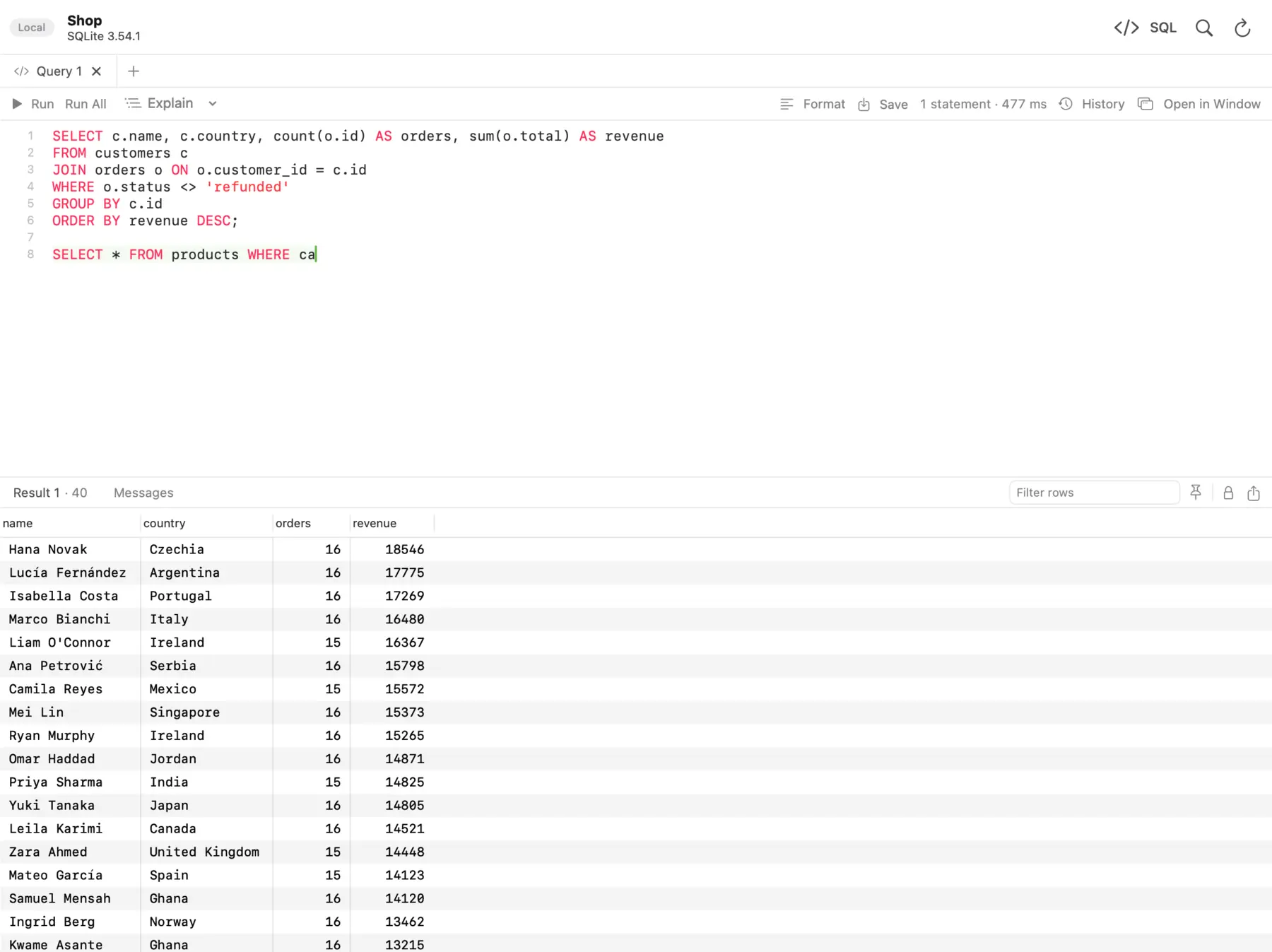 The dbPlus SQL editor, with the query's results below it.
Where it differs from Sequel Pro is safety. Edits are staged first, with changed cells in amber, new rows in green and deleted rows in red, and you can preview the SQL and commit it in one transaction or discard it. A connection marked Production asks before anything writes to it, and an UPDATE or DELETE without a WHERE clause asks first. After your Mac sleeps or the connection drops, dbPlus reconnects by itself and tells you if an open transaction was lost. With Premium it can also copy tables between databases, even from MySQL to PostgreSQL; our guide to copying a table from MySQL to PostgreSQL covers that job in general.
It's free with two connections and three tabs open at a time. dbPlus Premium costs USD 19 a year, with a one-week trial, and adds unlimited tabs and windows, SSH tunnels, structure editing, import, export, dumps and copying between databases. It needs macOS 14 Sonoma or later, and it collects no data.
Check the versions first. If you still run MySQL 5.7 or MariaDB older than 10.6, dbPlus doesn't support them, and Sequel Ace does. Many Sequel Pro users connect through SSH, and in dbPlus that's a Premium feature. It can import connections from TablePlus but not from Sequel Pro. It's Mac only, supports five engines, and isn't out yet.
DBeaver
DBeaver Community is free, open source and supports MySQL, MariaDB and nearly every other database. It has ER diagrams, data transfer and a capable SQL editor, and version 26.2.3 (18 October 2026) ships separate Apple silicon and Intel builds with Java included.
It's for people who want one free tool for everything. Paid PRO editions start at USD 113 a year. Coming from Sequel Pro, though, the Eclipse-based interface will feel crowded and un-Mac-like.
MySQL Workbench
Oracle replaced MySQL Workbench with a new generation in September 2026. MySQL Workbench 26.7 is rebuilt on MySQL Shell with an Electron interface, and Oracle says Workbench 8.0 has reached end of life and will get no new releases. It's free and open source.
The new version includes an SQL script editor, SQL notebooks, a redesigned Visual Explain, an SQL formatter, server status, performance reports, and user and privilege management. Oracle officially supports MySQL 8.4 LTS and newer; MySQL 8.0 and older versions may work but aren't supported. Oracle doesn't mention MariaDB.
It's for MySQL users who want Oracle's own tool for administration and tuning. Oracle also says some Workbench 8.0 features aren't in the new version yet, so check before you rely on one.
DataGrip
DataGrip is JetBrains' database IDE, with the most capable SQL editor here: schema-aware completion, refactoring and inspections. It handles MySQL, MariaDB and most other engines on macOS, Windows and Linux.
It's free for non-commercial use, though JetBrains requires anonymous usage statistics on that license. Paid work needs a commercial license, USD 109 for an individual's first year or USD 259 per user a year for organizations. Coming from Sequel Pro, expect a heavier, IDE-style app.
Moving your favorites out of Sequel Pro
If you're moving to Sequel Ace, its migration guide copies your saved connections across directly. Quit both apps first, then:
cp ~/Library/Preferences/com.sequelpro.SequelPro.plist \
  ~/Library/Containers/com.sequel-ace.sequel-ace/Data/Library/Preferences/com.sequel-ace.sequel-ace.plist

cp ~/Library/Application\ Support/Sequel\ Pro/Data/Favorites.plist \
  ~/Library/Containers/com.sequel-ace.sequel-ace/Data/Library/Application\ Support/Sequel\ Ace/Data/Favorites.plist
This replaces any connections already in Sequel Ace, so note them down first. Passwords don't come across, because Sequel Pro stored them in your Keychain; search Keychain Access for "Sequel Pro" to find them, then re-enter them. Reselect any SSH key files, since the sandboxed app needs your permission to read them.
For any other app, re-create the connections by hand. Before you uninstall Sequel Pro, open each favorite and write down the host, port, user, database, SSL settings and SSH tunnel details. If you're setting up SSH from scratch, our guide to connecting to a database through an SSH tunnel on Mac walks through it.
Which one should you pick?
If you want Sequel Pro back, install Sequel Ace. It's free, maintained and familiar, and for MySQL and MariaDB work it's hard to beat on value.
If you've grown into several databases, choose a multi-engine client. TablePlus is the most polished paid option, DBeaver is the free one, and DataGrip is for heavy SQL work. If you live in MySQL and want deep structure editing in a native app, Querious is worth a trial. MySQL Workbench makes sense if you want Oracle's tools and run MySQL 8.4 or newer.
dbPlus is the choice if you want Sequel Pro's native feel with more protection: staged edits, production marking and a guard against WHERE-less updates, at USD 19 a year, in an app that collects no data. It requires MySQL 8.0 or MariaDB 10.6 and newer, and it isn't released yet. For a wider look at the field, see our best MySQL and MariaDB clients for Mac.
Prices and features were checked on the vendors' sites in October 2026.
FAQ
Is Sequel Pro still maintained?
No. The last stable release, 1.1.2, came out in April 2016, and the main repository has had no new commits since 2020. Sequel Ace, a community fork, continues the project and had a release in October 2026.
Does Sequel Pro work with MySQL 8?
Not with MySQL 8's default caching_sha2_password authentication. You could switch an account to mysql_native_password, but that plugin is disabled by default in MySQL 8.4 and removed in 9.0, so the workaround is running out. Sequel Ace and the other maintained apps here are built for current MySQL versions.
Does Sequel Pro run on Apple silicon Macs?
The last release is an Intel build, so it runs only through Rosetta 2. Apple says Rosetta stays available as a general-purpose tool through macOS 27, so moving to a maintained, Apple silicon-native app is the safer plan.
Is Sequel Ace free?
Yes. Sequel Ace is free and open source under the MIT license and available on the Mac App Store. Version 6 needs macOS 13.5 Ventura or later.
Which Sequel Pro alternative also supports PostgreSQL?
TablePlus, DBeaver, DataGrip and dbPlus all handle PostgreSQL as well as MySQL and MariaDB. Sequel Ace, Querious and MySQL Workbench are MySQL-focused.